CHILD HEARING TEST AND ASSESSMENT

Child’s Hearing

A child’s quality of life and development vitally depends on hearing. Hearing helps the child learn to read, to enjoy music and to receive warnings of approaching harm. Child will have difficulty coping with many of life’s challenges and opportunity without good hearing. As a parent it is important to understand how your child hears, how to help your child prevent hearing loss and what to do if you suspect a hearing loss. Suspicion is the key to diagnosis and treatment.

Most babies are born with normal hearing and some are born with hearing problems. There are other children born with normal hearing but begin to have hearing problems as they grow older. Hearing from both ears (binaural hearing) allows child to localise the sound and also helps in understanding speech in a noisy background. Below is the guideline of age appropriate hearing milestones. Remember! Every child not the same and children reach milestones at different ages.
Age Milestones
Birth to 3 months
  • Reacts to loud sounds with a startle reflex.
  • Is soothed and quieted by soft sounds.
  • Turns head toward you when you speak.
  • Is awakened by loud voices or sounds.
  • Smiles in response to voices when spoken to.
  • Seems to recognize your voice and calms down when crying.
3 to 6 months
  • Looks or turns toward a new sound.
  • Responds to “no” and changes in tone of voice.
  • Imitates sounds made by self.
  • Begins to repeat sounds (e.g., ooh, aah, ba-ba).
  • Gets frightened by loud voices or noises.
6 to 10 months
  • Responds to own name, telephone ringing, or someone’s voice—even if not loud.
  • Recognizes words for common items (e.g., cup, shoe) and phrases (e.g., bye-bye).
  • Babbles even when alone.
  • Begins to follow simple requests (e.g., “come here”).
  • Looks at objects or pictures when mentioned.
10 to 15 months
  • Explores vocal sounds and enjoys hearing own voice.
  • Points to or looks at familiar people or objects when asked.
  • Imitates simple words and sounds; may use a few single words meaningfully.
  • Enjoys games like peek-a-boo and pat-a-cake.
  • Follows one-step commands when accompanied by gestures.
15 to 18 months
  • Follows simple directions (e.g., “Give me the ball”) without needing gestures.
  • Uses words learned frequently.
  • Forms 2 to 3-word sentences to express needs and ask for things.
  • Knows around 10 to 20 words.
  • Points to some body parts when asked.
18 to 24 months
  • Understands simple yes/no questions (e.g., “Are you hungry?”).
  • Understands simple phrases (e.g., “in the cup”, “on the table”).
  • Enjoys being read to.
  • Points to pictures when asked.
24 to 36 months
  • Understands phrases like “not now” and “no more”.
  • Chooses objects by size (e.g., big, little).
  • Follows two-step instructions (e.g., “Get your shoes and come here”).
  • Understands many action words (e.g., run, jump).

Signs of Hearing Difficulty

When parents notice that their child is not responding to the sound appropriately, this may be a signal of hearing loss. Sometimes it is difficult to detect mild hearing loss or when there is hearing loss in only one ear. It is important to remember that even mild hearing loss can have negative impact on child’s development. Children with mild hearing loss may have difficulty in school and can show attention, behavioural or social problem.

Watch out for some common warning signs for hearing loss which include:

  • Your Content Goes Here
  • Lack of attention or behavioural problem
  • Poorer than expected academic performance
  • Not responding to sounds or someone talking
  • Using ‘what or ‘huh’ frequently
  • Intently looking at speaker’s face
  • Difficulty understanding speech in group or background noise
  • Sitting close to TV or increasing TV volume
  • Unable to locate the source of sound accurately

  • Delayed speech and language development

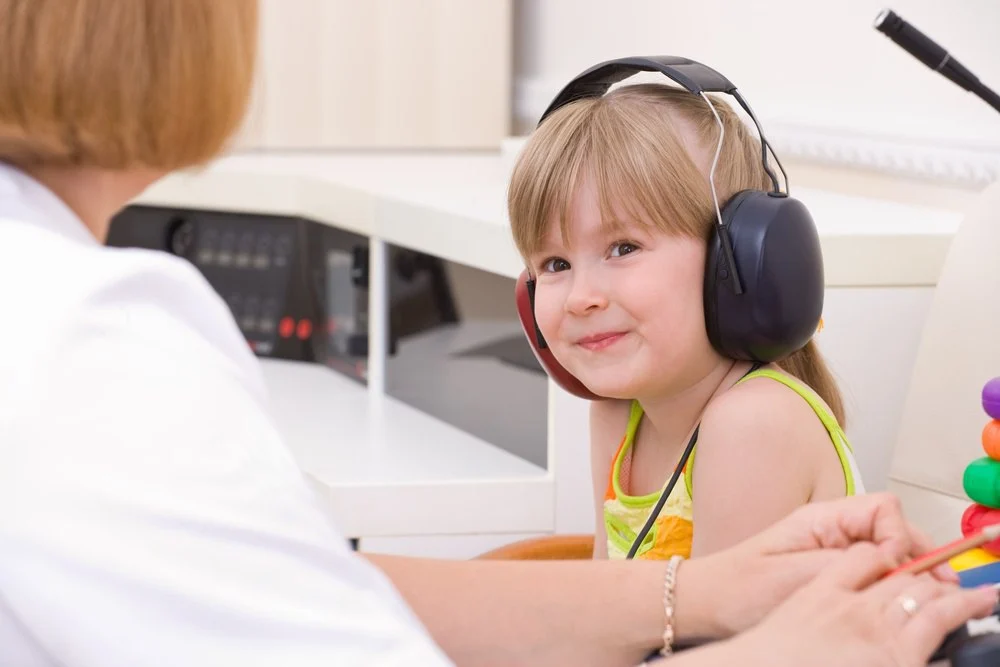
If you suspect any of the above and have concern over your child’s hearing you must contact your GP. A complete diagnostic hearing assessment is very important which will indicate about child’s hearing and also about his middle ear function.

At The Audiology Clinic the diagnostic hearing assessment is carried out by Doctor of Audiology Dr Deepak Kumar. Deepak is an Audiological Scientist specialises in hearing and balance.